

 By
Austin Coker
By
Austin Coker
Most B2B SaaS teams treat SEO as a blog-volume problem. Publish enough articles, the thinking goes, and traffic shows up. That model died years ago. In 2026, B2B SaaS SEO is a pipeline problem: a small set of high-intent commercial pages, a technically clean site that AI and Google can both parse, and earned authority that competitors cannot fake.
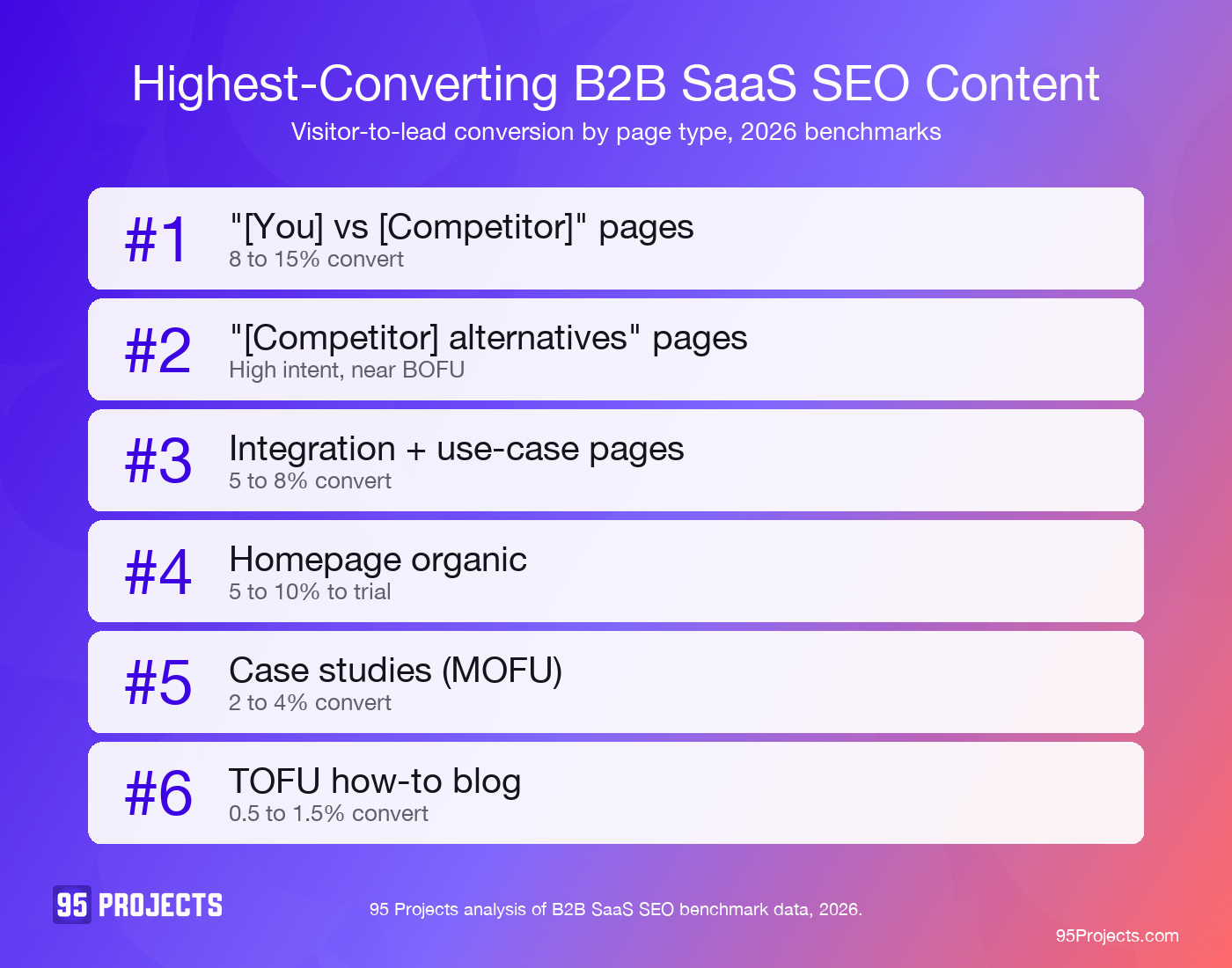
The reason the blog-volume model fails is conversion math. A how-to blog post converts organic visitors to leads at roughly 0.5 to 1.5 percent. A bottom-of-funnel comparison page, the kind a buyer reads right before they pick a vendor, converts at 8 to 15 percent. Same traffic source, ten times the pipeline. The teams that grow with SEO are the ones who build the second kind of page and treat the first kind as support, not strategy.
Here is the buyer journey that actually drives B2B SaaS pipeline, and the content that wins at each stage. We do this for our own B2B SaaS SEO clients and for ourselves, which is how we know the conversion gaps are this wide:
| Buyer stage | What they search | Page that wins | Visitor-to-lead |
|---|---|---|---|
| Problem-aware (TOFU) | “how to reduce churn in SaaS” | Educational how-to + framework | 0.5 to 1.5% |
| Solution-aware (MOFU) | “best tools for [job to be done]” | Category + use-case pages | 5 to 8% |
| Vendor-aware (BOFU) | “[your product] vs [competitor]” | Comparison + alternatives pages | 8 to 15% |
| Validating (BOFU) | “[your product] reviews / case study” | Proof + case study pages | 2 to 4% |
If your SEO program is 90 percent TOFU blog posts and 10 percent everything else, you have inverted the funnel. The fix is not more content. It is the right content, built in the right order, on a site Google and ChatGPT can trust.
When a B2B SaaS SEO program works, the results do not come from where most people think. Backlinks get all the attention, but they are the smallest lever of the three. Here is the honest breakdown of where organic results come from, based on what actually moves rankings and pipeline in this niche:
| Pillar | Share of results | What it covers | Can you do it in-house? |
|---|---|---|---|
| On-page + content | ~70% | High-intent pages, search-intent match, on-page optimization, selling inside the content | Mostly yes, with a real content operator |
| Technical + internal linking | ~20% | Schema, page speed, crawlability, a deliberate internal link architecture | Yes, this is the most DIY-able layer |
| Backlinks + authority | ~10% | Earned links from relevant, real-traffic sites; digital PR; founder-led content | This is where in-house teams cap out |
That last row is the honest one. Scaling backlinks is not about volume. A page that earns 100-plus relevant backlinks reliably ranks in the top five for competitive terms, and B2B SaaS brands typically need a domain rating in the low 50s to compete nationally. Hitting that takes earned links from sites that are topically relevant and have real organic traffic of their own. Vetting for relevance and traffic, then earning the link without buying it, is slow, manual work. It is exactly where a specialist SEO partner earns its keep, and where most internal teams stall out after the first quarter.
The other two pillars, though, you can and should own. Technical foundation and high-intent content are 90 percent of the result and the most controllable. Start there.
We will run the numbers on your technical foundation, content gaps, and authority, and show you the highest-leverage fixes first.
This is the part of the guide where we give away the playbook. None of it is secret. The hard part is not knowing what to do, it is doing all of it consistently, in the right order, for the months it takes to compound. Here are the five steps, in sequence.
Before you write a single new page, make sure the site you have can be crawled, rendered, and trusted. This is the most DIY-able work in SEO and the cheapest to fix. Audit four things: page speed (Core Web Vitals, especially on your template pages), schema markup (Organization, Product, SoftwareApplication, FAQ), crawl and index hygiene (no orphan pages, no thin doorway pages eating crawl budget), and internal linking.
Internal linking is the lever almost everyone underuses. Your high-intent comparison and use-case pages should receive links from your highest-authority pages, not sit three clicks deep with one inbound link. A deliberate internal link map moves rankings without a single new backlink. We covered the AI-search side of this in our companion guide on getting recommended by ChatGPT, because the same clean structure that helps Google also helps AI engines cite you.
This is where pipeline comes from. Build the pages buyers read right before they choose, in this priority order: comparison pages (“[your product] vs [competitor]”), alternatives pages (“best [competitor] alternatives”), integration pages, and use-case or job-to-be-done pages. These are the 8-to-15-percent converters from the table above.
The mistake to avoid: do not write these as thin doorway pages. A comparison page that actually helps a buyer decide, with honest trade-offs and real data, is the one that ranks and converts. Sell inside the content, but earn the click first. Sites that publish four or more pages a month inside one tight topical cluster earn 2.1 times more referring domains and 1.8 times more organic sessions than sites publishing fewer than two. Depth in one cluster beats spreading thin.
Backlinks still matter, but the rules changed. One link from a relevant SaaS publication with real traffic outweighs a hundred from directories and link farms, and Google is increasingly good at discounting the latter. The durable plays for B2B SaaS are founder-led content (the founder’s own lessons, data, and contrarian takes earn links the brand account never could), original research and data studies, and being included in the third-party listicles your buyers actually read.
That last one is worth saying plainly: when a buyer searches “best B2B SaaS SEO agencies” or “best [your category] tools,” the listicles that rank are themselves a citation channel. Getting placed in them, legitimately, is an ongoing outreach program. It is the same reason we maintain our own vetted list of the best B2B SaaS SEO agencies. Earned placement at scale is slow, relationship-driven work, and it is the part most in-house teams never get to.
Rankings and sessions are vanity until they tie to pipeline. Instrument the chain: organic visitor to lead, lead to MQL, MQL to SQL, SQL to closed revenue. The benchmarks are knowable. SEO-sourced leads in B2B convert to MQL at around 41 percent and MQL to SQL at roughly 51 percent, both stronger than most paid channels, because the intent is higher. If your organic traffic is growing but pipeline is not, you are ranking for the wrong queries. Re-point the program at the BOFU terms from Step 2.
This is also the metric that justifies the investment internally. Organic gets you to a sub-100-dollar customer acquisition cost by around month 18, versus 150 to 300 dollars on paid. The Constant Hire case study is the clearest version of this in our own work: a B2B program where the compounding organic and AI-search wins outran paid on cost per acquisition once the content layer matured.
SEO is not slow, but it is not instant either, and pretending otherwise is how programs get killed in month three. Here is the honest timeline and what it costs, based on current B2B SaaS benchmarks:
| Milestone | When it shows up | What to watch |
|---|---|---|
| First ranking movement | Month 1 to 2 | Target pages entering the top 20 to 30 |
| Measurable traffic growth | Month 2 to 4 | 15 to 20% quarter-over-quarter at $10M to $30M ARR |
| Measurable pipeline | Month 2 to 6 | Organic leads at 2 to 3% visitor-to-lead |
| Meaningful ROI | ~Month 7 | Cost per acquisition trending below paid |
| Compounding moat | Month 12+ | Topical authority competitors cannot quickly copy |
On budget: most B2B SaaS companies invest 3,000 to 8,000 dollars a month to reach meaningful ROI, with early-stage teams starting around 2,000 to 3,000 and Series B-plus programs running 6,000 to 12,000. Average B2B SaaS SEO ROI lands around 700 percent over a multi-year horizon, which is the entire reason it is worth the patience.
See how we run sustained, revenue-tied SEO for B2B SaaS companies, from technical foundation to the BOFU content that converts.
Everything above is doable in-house. The honest question is not whether you can, it is whether you can sustain all of it at once. Most in-house teams do one or two pillars well and let the others slip, usually backlinks and the BOFU content cadence, which are the two that compound. Here is the realistic comparison:
| Capability | Typical in-house team | Specialist B2B SaaS SEO partner |
|---|---|---|
| Technical foundation | Strong, one-time fixes | Strong, continuously monitored |
| High-intent content cadence | Starts strong, stalls under product/marketing load | Sustained, the core deliverable |
| Backlink + authority program | Rarely sustained at scale | Ongoing outreach + digital PR engine |
| Revenue attribution | Often stops at rankings | Tied to pipeline and CAC |
| AI-search optimization | New, usually unstaffed | Built in alongside SEO |
The point is not that you should outsource everything. It is that the pillars most teams drop, sustained BOFU content and earned authority, are exactly the ones that decide whether the program compounds or plateaus. If you want a vetted shortlist of partners who do this for B2B SaaS specifically, we keep one: the best B2B SaaS SEO agencies, alongside our best B2B SaaS GEO agencies and best B2B SaaS PPC agencies lists for the adjacent channels.
There is a closing window here, and it looks a lot like Google SEO did from 2008 to 2014. In that era, the companies that built topical authority early opened a moat that later entrants could not buy their way past, no matter the budget. The same dynamic is playing out now, twice over: once in Google’s increasingly authority-weighted rankings, and again in AI search, where ChatGPT and Perplexity cite the sources that already earned trust.
B2B SaaS is a category where buyers research heavily before they ever talk to sales, and more of that research now starts with an AI prompt. The brands building clean, high-intent, well-linked content today are the ones those engines will cite tomorrow. The ones waiting for SEO to feel urgent will be buying their way in against an incumbent who started two years earlier. Here is the short version of where to start this quarter:
| Do this now | Why it matters |
|---|---|
| Audit Core Web Vitals + schema | Cheapest fix, unlocks everything downstream |
| Map internal links to your BOFU pages | Moves rankings with zero new backlinks |
| Ship one comparison page | Your highest-converting page type, build it first |
| Instrument visitor-to-revenue | Proves the program before budgets get questioned |
| Start earned-link outreach | The slow lever, so start it earliest |
None of these require a big budget to begin. They require starting before the window narrows further.
Book a free strategy call. We will map your organic opportunity against your real pipeline goals, no pitch deck required.
You are reading this right now.
This article exists because we saw an opportunity and wrote it. It ranks because we optimized it. You found it because we know how to get found online.
That is not a coincidence. It is the entire point.
We are a search marketing agency. You are reading our content because our search marketing works. The strategies in this guide are the same ones we use to generate our own pipeline.
We specialize in integrated SEO, Google Ads, and Generative Engine Optimization (GEO) for $1M to $50M B2B brands. B2B SaaS is one of our deepest verticals, from vertical SaaS and developer tools to cybersecurity SaaS and fintech platforms. The Constant Hire case study is the clearest proof of this playbook compounding into pipeline.
If you want to go deeper or hand it off: see how we run SEO for SaaS companies, explore our AI search work for startups, or compare vetted partners on our best B2B SaaS SEO agencies list. When you are ready, book a call and we will tell you exactly where your organic program stands.

Have questions about working with us? Book a 30-minute strategy call to discuss your goals and see if we’re a good fit.
No-pressure conversation
Clear next steps (if we’re a fit)
Talk directly to an expert
Expect first ranking movement in month 1 to 2, measurable traffic growth by month 2 to 4, and measurable pipeline between months 2 and 6. Meaningful ROI, where cost per acquisition trends below paid, typically lands around month 7. The compounding moat builds from month 12 onward.
Most B2B SaaS companies invest 3,000 to 8,000 dollars a month to reach meaningful ROI within about seven months. Early-stage teams often start at 2,000 to 3,000, while Series B and later programs run 6,000 to 12,000. Average B2B SaaS SEO ROI lands near 700 percent over a multi-year horizon.
Bottom-of-funnel pages. “[Your product] vs [competitor]” comparison pages and “[competitor] alternatives” pages convert organic visitors at 8 to 15 percent, versus 0.5 to 1.5 percent for top-of-funnel blog posts. Build the comparison and alternatives pages first, then support them with educational content.
Yes, but quality and relevance matter far more than volume. A page with 100-plus relevant backlinks reliably ranks in the top five for competitive terms, and B2B SaaS brands generally need a domain rating in the low 50s to compete nationally. One link from a relevant, real-traffic SaaS publication outweighs a hundred low-quality links.
The technical foundation and most on-page content work are very doable in-house, and together they drive about 90 percent of results. The two pillars that usually stall are a sustained BOFU content cadence and an ongoing earned-link program, which are also the two that compound. Those are where a specialist partner earns its keep.
B2B SaaS buyers research heavily before contacting sales, the sales cycle is long, and the highest-value queries are vendor-comparison and alternatives terms. That makes BOFU commercial content disproportionately valuable, and it makes integration, use-case, and comparison pages more important than high-volume informational keywords.
The same clean structure, schema, and earned authority that rank you on Google also make AI engines confident enough to cite you. We cover the AI-search side in detail in our companion guide on how B2B SaaS companies get recommended by ChatGPT. Running SEO and GEO together compounds, because both reward trusted, well-structured content.
Inverting the funnel: spending 90 percent of the effort on top-of-funnel blog volume and almost nothing on the BOFU comparison and alternatives pages that actually convert. More content is not the fix. The right content, built in the right order on a technically clean site, is.
For B2B SaaS, yes. PPC buys immediate presence on high-intent terms while SEO compounds toward a sub-100-dollar cost per acquisition over time. Running them together lets paid data inform which organic pages to build first, and lets organic lower blended acquisition cost as it matures. The two channels share the same buyer-intent map.