

 By
Austin Coker
By
Austin Coker
Reading time: 8 min
Most B2B SaaS marketing strategies are really just a list of channels with a budget next to each one. SEO over here, paid over there, a separate line for content, maybe someone owns AI search now. That is not a strategy. It is an org chart, and it is the reason so many SaaS marketing teams stay busy without compounding.
A real B2B SaaS marketing strategy in 2026 is three things working as one system: sharp positioning, a budget sized to your stage, and channels that feed each other instead of competing for credit. The companies that win are not the ones with the most channels. They are the ones whose channels share a buyer-intent map and get measured on revenue, not clicks.
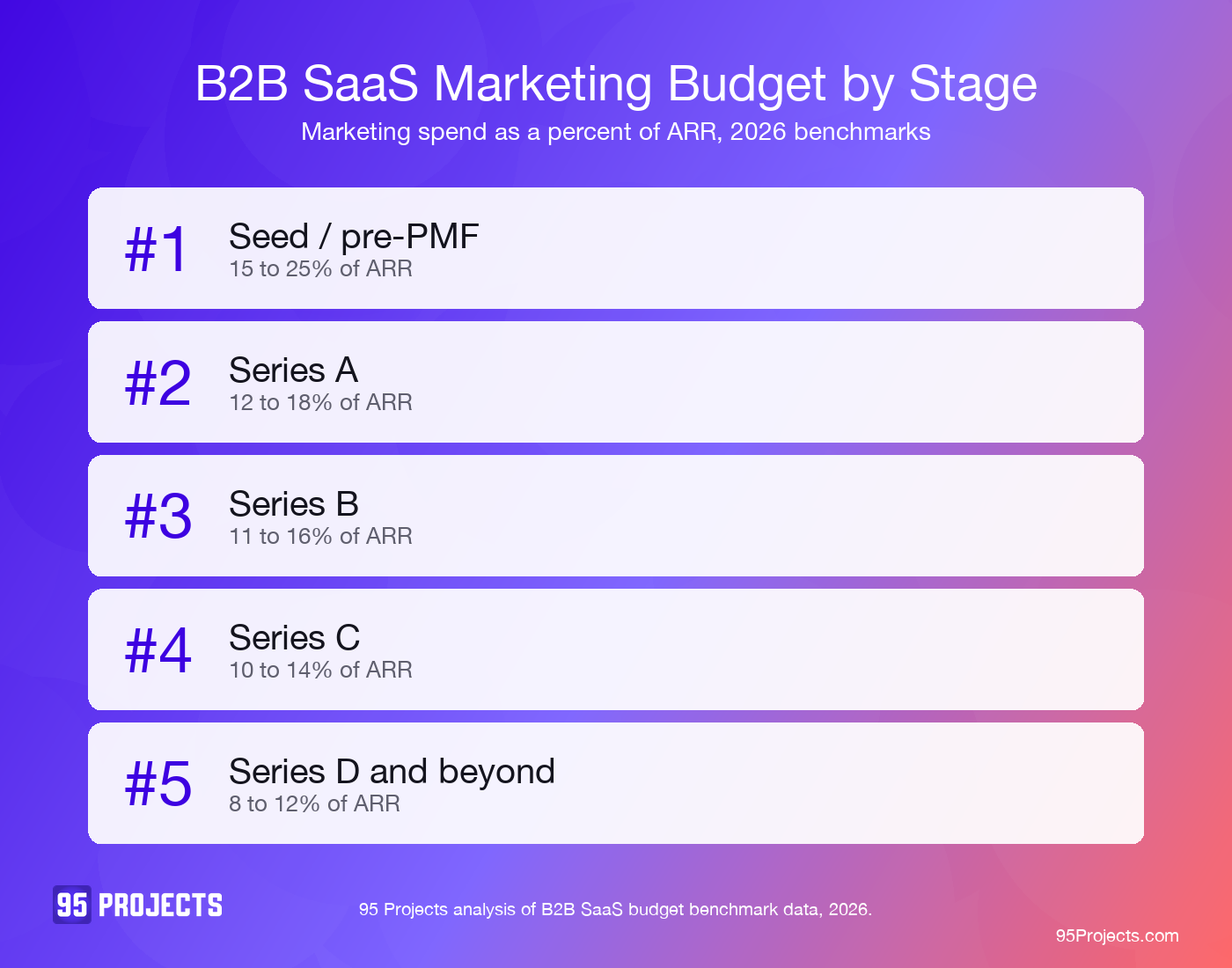
Start with what you should actually spend. Marketing budget as a percentage of ARR is well-benchmarked, and it shrinks as you scale because efficiency compounds:
| Stage | Marketing as % of ARR | What the budget is buying |
|---|---|---|
| Seed / pre-PMF | 15 to 25% | Signal: which segments and messages convert |
| Series A | 12 to 18% | Repeatable pipeline from 2 to 3 proven channels |
| Series B | 11 to 16% | Scale + a durable organic and AI-search moat |
| Series C | 10 to 14% | Efficiency: blended CAC down, expansion up |
| Series D and beyond | 8 to 12% | Compounding brand + category leadership |
If you are spending at the top of your stage’s range and still cannot predict next quarter’s pipeline, the problem is rarely budget. It is that the channels are running as silos.
Here is the part most strategies miss. SEO, paid, and AI search optimization (GEO) are not three programs. They are three views of the same buyer, and when you run them together they compound. Paid buys presence on high-intent terms today. SEO compounds those same terms toward a far lower cost per acquisition over time. GEO makes sure that when a buyer asks ChatGPT or Perplexity instead of Google, your brand is the one cited. One buyer-intent map feeds all three.
The integrated budget split that high-performing B2B SaaS teams converge on is roughly 40 percent organic and SEO, 40 percent paid acquisition, and 20 percent retention and expansion. The exact mix shifts with your average contract value, because intent lives in different places:
| If your ACV is… | Paid lean | Why |
|---|---|---|
| Under $30K (SMB) | 60 to 70% into Google Ads + brand search | Buyers self-serve and search; capture high intent cheaply |
| $30K to $150K (mid-market) | Balanced Google + LinkedIn + organic | Mixed self-serve and sales-led; blend volume with targeting |
| $150K+ (enterprise) | 50 to 60% into LinkedIn + ABM | Committee buying; precision targeting beats raw volume |
The reason this matters: the single biggest lever on growth is not a channel, it is the integration between them. Paid data tells you which organic pages to build first. Organic rankings lower the cost of your paid terms. Both feed the third-party authority that gets you cited in AI search. Run them in three separate silos or three separate agencies and you pay an integration tax every quarter.
We will map your SEO, paid, and AI-search spend against one buyer-intent model and show you where the integration tax is costing you pipeline.
This is the open-book version of how to actually build the strategy. None of it is proprietary. The discipline is in doing all five steps as one connected system rather than five disconnected projects.
Positioning is not your tagline. It is the decision about which problem you solve, for whom, and why you are the best answer. It is upstream of everything: it determines which keywords are worth ranking for, which comparison pages matter, what your paid ads say, and what AI engines understand you to be. Get it wrong and every channel amplifies the wrong message efficiently.
Write it down in one sentence a buyer would recognize: for [specific buyer] who struggles with [specific problem], you are the [category] that [unique mechanism], unlike [the alternative they would otherwise pick]. Every channel decision after this should trace back to that sentence.
Use the percentage-of-ARR benchmarks above as guardrails. Underspending at seed starves the signal you need to find product-market-message fit; overspending at Series C papers over a channel that is not actually efficient. Then split the budget across the integrated model: roughly 40 percent organic and SEO, 40 percent paid, 20 percent retention and expansion. Expansion is the quietly dominant lever, expansion revenue now accounts for around 40 percent of new ARR at healthy SaaS companies, at a fraction of new-logo acquisition cost.
The two companion guides go deeper on the execution: see how B2B SaaS companies grow with SEO for the organic half, and how B2B SaaS companies get recommended by ChatGPT for the AI-search half.
This is where strategies live or die. Build one buyer-intent map: the questions, comparisons, and decision moments your buyer moves through. Then point every channel at the same map. Paid bids on the highest-intent terms now and feeds back which queries convert. SEO builds durable pages for those same queries so the cost per acquisition falls over time. GEO ensures the comparison and authority content that ranks also gets cited when the buyer asks an AI engine instead. Same map, three compounding motions.
The benchmark this unlocks: bottom-of-funnel terms produce the lowest blended cost per acquisition of any channel mix, because you are capturing buyers who are already evaluating. Companies that rank and bid on those terms together consistently report the lowest blended CAC in their segment.
One asset should work across all three channels: high-intent comparison and alternatives pages (“[your product] vs [competitor]”, “best [competitor] alternatives”, pricing and use-case pages). The same page ranks organically, serves as a high-converting paid landing page, and becomes the citation AI engines pull when a buyer asks for a recommendation. Build it once, deploy it three ways. That is the integration dividend in its purest form.
This is also why siloed teams underperform: a separate SEO team, paid team, and content team each build their own version of this asset, or none of them owns it. One team building one set of BOFU assets for all three channels is structurally more efficient.
Vanity metrics are the enemy of strategy. Measure what moves the business: net revenue retention, CAC payback, pipeline coverage, and LTV to CAC. These are knowable and benchmarked by segment, which lets you tell quickly whether the strategy is working or just busy:
| Metric | Healthy (median) | Strong (top quartile) |
|---|---|---|
| CAC payback, SMB ($5K to $15K ACV) | 6 to 9 months | Under 6 months |
| CAC payback, mid-market ($15K to $50K) | 9 to 14 months | Under 9 months |
| CAC payback, enterprise ($50K+) | 12 to 18 months | Under 12 months |
| LTV to CAC ratio | 3:1 | 5:1 or better |
| MQL to SQL conversion | 13 to 22% | 25 to 35% |
If a channel cannot be traced to one of these, it is a hobby, not a strategy line. Re-point the budget at the motions that move them.
See how we run integrated SEO, PPC, and GEO for B2B SaaS, with one buyer-intent map and one revenue picture instead of three silos.
The most common failure is not a bad channel, it is a fragmented operating model. Three siloed in-house teams, or worse, three separate agencies (one for SEO, one for paid, one that just appeared for AI search) each optimize their own metric and none of them owns the buyer-intent map. The result is duplicated work, contradictory messaging, and a blended CAC that never improves. Here is the realistic comparison:
| Dimension | Siloed teams / agencies | Integrated B2B SaaS partner |
|---|---|---|
| Buyer-intent map | Three different versions, or none | One shared map across all channels |
| BOFU content | Built three times or owned by no one | Built once, deployed across SEO, paid, GEO |
| Paid-to-organic feedback loop | Lost between teams | Paid data directly shapes the SEO roadmap |
| Reporting | Three dashboards, three metrics | One revenue picture: pipeline, CAC, NRR |
| Blended CAC over time | Flat, integration tax every quarter | Falls as channels compound |
The fix is not necessarily to outsource everything. It is to make sure one team owns the integrated strategy, even if specialists execute the pieces. If you want a vetted shortlist of partners who run this integrated for B2B SaaS, we keep three: best B2B SaaS SEO agencies, best B2B SaaS GEO agencies, and best B2B SaaS PPC agencies.
Integrated strategy compounds, and that compounding is a moat. A competitor can copy your ad copy in an afternoon and your blog topics in a quarter. What they cannot quickly copy is two years of integrated authority: rankings that lowered your paid costs, comparison pages that both rank and get cited by AI engines, and an expansion motion that funds new-logo acquisition. That stack takes years to assemble and minutes to lose to a competitor who started earlier. The teams treating SEO, paid, and GEO as one system today are building a structural lead their single-channel competitors cannot close by simply spending more, because you cannot buy back two years of compounding in a quarter.
B2B SaaS buyers research heavily before they ever talk to sales, and more of that research now starts with an AI prompt. The brands running SEO, paid, and GEO as one system are the ones those engines cite and those buyers shortlist. Here is the short version of where to start this quarter:
| Do this now | Why it matters |
|---|---|
| Write your one-sentence positioning | Every channel decision traces back to it |
| Set budget by stage + the 40/40/20 split | Guardrails against over- and under-spending |
| Build one buyer-intent map for all channels | Kills the integration tax |
| Ship one BOFU comparison page | Works across SEO, paid, and AI citations at once |
| Switch reporting to revenue metrics | Proves the strategy before budgets get cut |
None of this requires a bigger budget. It requires running what you already spend as one system instead of three.
Book a free strategy call. We will pressure-test your positioning, budget, and channel mix against your pipeline goals, no pitch deck required.
You are reading this right now.
This article exists because we saw an opportunity and wrote it. It ranks because we optimized it. You found it because we know how to get found online.
That is not a coincidence. It is the entire point.
We are a search marketing agency. You are reading our content because our search marketing works. The strategies in this guide are the same ones we use to generate our own pipeline.
We specialize in integrated SEO, Google Ads, and Generative Engine Optimization (GEO) for $1M to $50M B2B brands. B2B SaaS is one of our deepest verticals, and integration is the whole thesis: one buyer-intent map, one team, three compounding channels. The Constant Hire case study is the clearest proof of that integrated approach turning into pipeline.
To go deeper or hand it off: read how B2B SaaS companies grow with SEO, see how we run SEO for SaaS companies, or compare vetted partners on our best B2B SaaS SEO agencies list. When you are ready, book a call and we will map your channels against your real pipeline goals.

Have questions about working with us? Book a 30-minute strategy call to discuss your goals and see if we’re a good fit.
No-pressure conversation
Clear next steps (if we’re a fit)
Talk directly to an expert
As a percentage of ARR, plan for 15 to 25% at seed, 12 to 18% at Series A, 11 to 16% at Series B, 10 to 14% at Series C, and 8 to 12% at Series D and beyond. The percentage falls as you scale because integrated channels compound and blended cost per acquisition drops.
The integrated model that high-performing teams converge on is roughly 40 percent organic and SEO, 40 percent paid acquisition, and 20 percent retention and expansion. The paid mix then shifts by deal size: SMB leans into Google Ads, enterprise leans into LinkedIn and ABM.
Together. They are three views of the same buyer. Paid captures intent now, SEO compounds the same terms toward a lower cost per acquisition, and GEO gets you cited in AI search. One buyer-intent map should feed all three. Running them as silos creates duplicated work and a blended CAC that never improves.
Treating the strategy as a list of channels with separate teams or agencies, instead of one integrated system. Siloed channels each optimize their own metric, no one owns the buyer-intent map, and you pay an integration tax every quarter while blended CAC stays flat.
Revenue metrics, not clicks: net revenue retention, CAC payback, pipeline coverage, and LTV to CAC. Healthy CAC payback runs 6 to 9 months for SMB, 9 to 14 for mid-market, and 12 to 18 for enterprise, with a 3:1 LTV-to-CAC ratio as the median target and 5:1+ for top performers.
Upstream of everything. Positioning is which problem you solve, for whom, and why you are the best answer. It determines which keywords matter, what your ads say, and how AI engines understand you. Get it wrong and every channel amplifies the wrong message efficiently. Write it as one sentence before you touch a channel.
Because one BOFU asset works across all three channels. A strong comparison or alternatives page ranks organically, converts as a paid landing page, and gets cited by AI engines, all at once. Companies that rank and bid on bottom-of-funnel terms together report the lowest blended cost per acquisition in their segment.
A large one. Expansion revenue now accounts for around 40 percent of new ARR at healthy SaaS companies, at a fraction of new-logo acquisition cost. A strategy that pours everything into new-logo acquisition and underfunds retention and expansion leaves the most efficient growth on the table. The 20 percent expansion line in the integrated model is deliberate.
The strategy and the buyer-intent map should be owned in-house regardless of team size. Execution is where most small teams stall, sustaining BOFU content, an earned-link program, and AI-search optimization at once is a lot for two or three people. That is where one integrated partner, rather than three siloed ones, earns its keep.