

 By
Austin Coker
By
Austin Coker
Reading time: 8 min
The way B2B SaaS buyers find software broke from the old playbook, and most marketing teams have not caught up. The single biggest shift: as of 2026, 51 percent of B2B software buyers start their research inside an AI chatbot, not a search engine. That is up from 29 percent just a year earlier. Seventy-one percent now rely on AI chatbots somewhere in the process.
The second shift is older but still under-served: the buying journey is mostly invisible. Buyers complete 70 to 83 percent of their research before they ever contact a vendor, and roughly 73 percent of the journey happens anonymously, in what gets called the dark funnel. A modern buyer consumes 20 to 30 pieces of content, across AI chatbots, review sites, peer communities, podcasts, and analyst reports, before a single rep is involved.
Here is where they actually go, and how much weight each source carries:
| Where buyers research | What it tells them | Weight in 2026 |
|---|---|---|
| AI chatbots (ChatGPT, Perplexity) | A synthesized shortlist and comparison | 51% start here, rising fast |
| Review sites (G2, TrustRadius) | Crowd-sourced peer validation | Jumped from 13% to 31% of top sources |
| Peer communities + word of mouth | Trusted, unfiltered opinions | 65% of CMOs start here; 42% rank it #1 |
| Comparison + alternatives pages | Head-to-head decision support | Consulted right before shortlisting |
| Podcasts, analyst reports, content | Depth and credibility signals | Part of the 20 to 30 pieces consumed |
The implication is uncomfortable: by the time a buyer talks to your sales team, the decision is mostly made. If you are not present in those sources, you are not in the consideration set, and you will never know you lost.
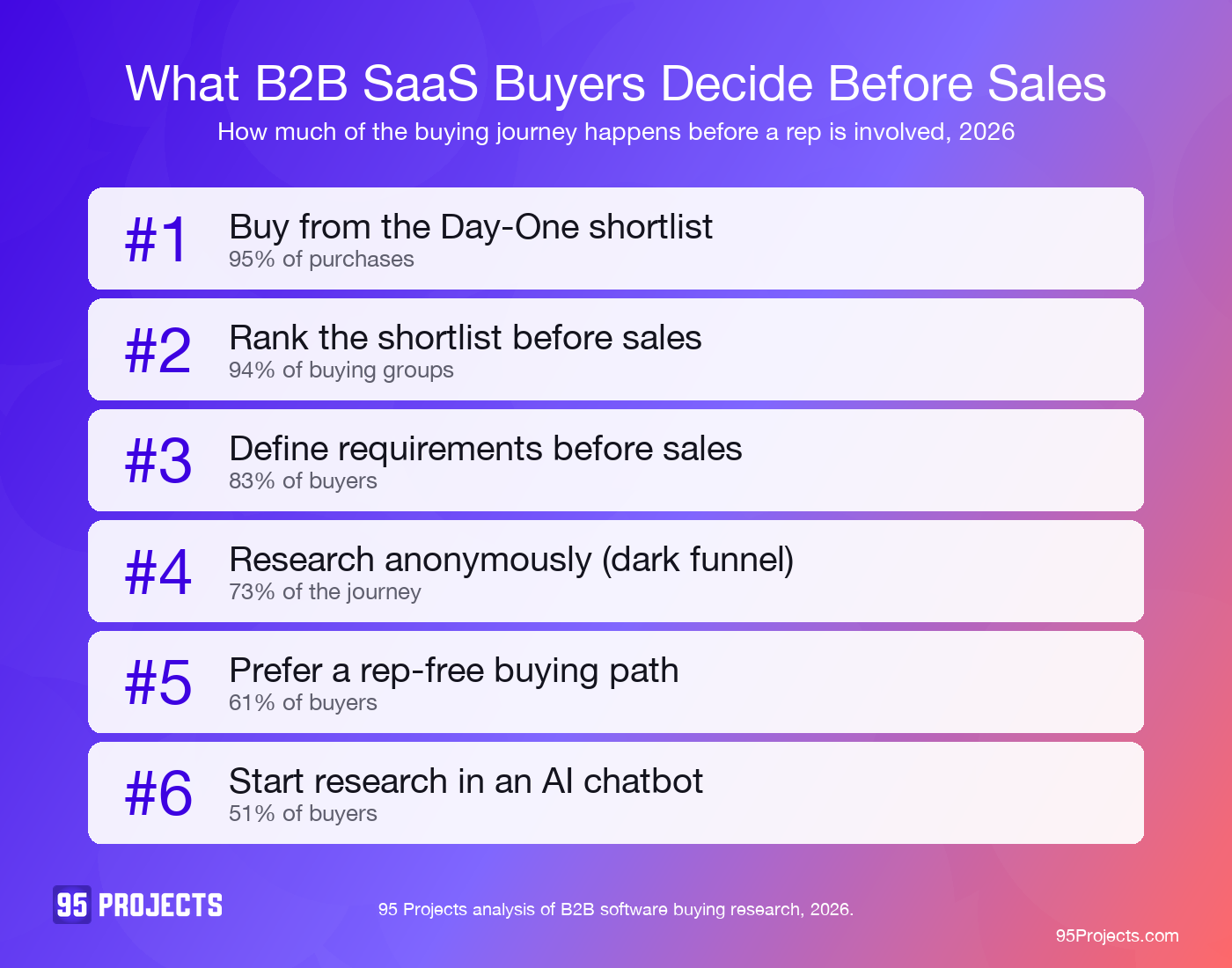
Here is the statistic that should reframe your entire marketing plan: 95 percent of B2B purchases come from the buyer’s Day-One shortlist, the set of vendors they already had in mind before formal evaluation began. Ninety-four percent of buying groups rank that shortlist before they ever contact sales, and the vendor ranked number one wins roughly 80 percent of the time.
It gets more pointed. Ninety-two percent of buyers start with at least one vendor in mind, 41 percent have already picked a preferred vendor before evaluation, and 83 percent have their requirements mostly defined before talking to anyone. The shortlist forms in the dark funnel, where you cannot track it, and it is nearly locked by the time you can.
One more wrinkle that makes this winnable: 69 percent of buyers say they chose a different vendor than they originally planned based on AI chatbot guidance, and a third bought from a vendor they had never heard of before. The shortlist is set early, but AI search is actively reshaping it. That is the opening. The journey looks like this:
| Stage | Where it happens | What earns a spot |
|---|---|---|
| Discover | AI chatbots, peer communities | Being cited as a credible option, unprompted |
| Shortlist | Reviews, comparisons, AI synthesis | Strong G2/TrustRadius presence + comparison pages |
| Validate | Case studies, peer references, demos-on-demand | Proof that matches their use case |
| Decide | Internal consensus across 6 to 11 stakeholders | Being the clear, low-risk number one |
We will check whether AI chatbots, review sites, and comparison pages surface you at the moment buyers build their shortlist, and where you are invisible.
You cannot sell your way onto a shortlist that is already set. You earn the spot earlier, in the sources buyers actually use. Here is the open-book playbook for being on the Day-One shortlist, in priority order.
With 51 percent of buyers beginning in an AI chatbot, your first job is to be the brand those engines cite when someone asks for options in your category. That is a learnable discipline, not luck. It depends on structured, extractable content, third-party citations, and schema that AI engines can parse. We wrote the full version in our companion guide on how B2B SaaS companies get recommended by ChatGPT. If you are invisible in AI search, you are invisible at the exact moment half your buyers form their first impression.
Review platforms jumped from 13 percent to 31 percent of buyers’ most-consulted sources in three years, and there is a compounding reason to care: large language models treat aggregated peer reviews as crowd-sourced intelligence and weight them above vendor claims. When ChatGPT recommends software, it routinely references G2 and TrustRadius ratings. A deliberate program to earn recent, specific, high-volume reviews is no longer a nice-to-have, it feeds both the human shortlist and the AI one.
Buyers in the shortlist stage run a predictable set of high-intent searches, and the pages that answer them get read right before the shortlist locks. These are the highest-leverage pages you can build, because they rank in Google, convert directly, and get cited by AI engines, the same asset working across every channel. Here is the query-to-content map:
| Query buyers run | What they are deciding | Page that wins |
|---|---|---|
| “[vendor A] vs [vendor B]” | Final head-to-head choice | Honest comparison page |
| “best [competitor] alternatives” | Whether to replace an incumbent | Alternatives page with real trade-offs |
| “[category] for [use case]” | Whether you fit their situation | Use-case / job-to-be-done page |
| “[vendor] reviews” | How risky the choice is | Strong G2/TrustRadius profile + case studies |
| “[vendor] pricing” | Whether it fits the budget | Transparent, self-serve pricing page |
Build these honestly, not as thin doorway pages. The comparison page that actually helps a buyer decide is the one that ranks, converts, and gets cited. This is the core idea in our B2B SaaS marketing strategy guide: one bottom-of-funnel asset, deployed across every channel at once.
Most of the journey, that 73 percent that happens anonymously, plays out in peer communities, podcasts, and shared content that never shows up in your attribution. You cannot track it, but you can feed it. Show up in the communities your buyers trust, get founders and experts on the podcasts they listen to, and publish the kind of content that gets shared in private Slacks and forums. The payoff is real: deals that first appear through these untracked touchpoints close meaningfully faster than tracked ones, because the trust was built before you ever knew the buyer existed.
Sixty-one percent of buyers prefer a rep-free buying experience, and they spend only about 17 percent of their buying time with vendors. Respect that. Put your pricing where they can find it, make comparison and use-case information self-serve, offer demos on demand, and let the buyer get to a decision without a gate at every step. The companies that force a sales call to learn basic facts get quietly removed from the shortlist. The Constant Hire case study is a clear example of meeting buyers in these self-serve, AI-driven moments rather than waiting for a form fill.
See how we put B2B SaaS brands in front of buyers earlier, in AI search, reviews, and the comparison pages that decide the shortlist.
Most B2B SaaS companies still build their marketing around the 17 percent of the journey they can see, the demo, the sales call, the form fill, and underinvest in the 73 percent they cannot. They optimize the bottom of the funnel and ignore the dark funnel where the shortlist actually forms. Here is the realistic comparison of how teams respond to the new buyer:
| Capability | Typical B2B SaaS team | Buyer-journey-aligned partner |
|---|---|---|
| AI search presence | Unstaffed, invisible in chatbots | Actively optimized to be cited |
| Review-site program | Ad hoc, sporadic review asks | Systematic, recent, high-volume reviews |
| Comparison + alternatives pages | Few or none, or thin doorway pages | Honest, ranking, AI-cited decision pages |
| Dark-funnel presence | Untracked, so unfunded | Funded: communities, podcasts, shareable content |
| Self-serve buying path | Gated behind sales | Frictionless, rep-free by design |
The fix is to fund the parts of the journey you cannot measure, because that is where 95 percent of the decision happens. If you want a shortlist of partners who optimize for the AI-first, dark-funnel buyer, we keep one for B2B SaaS: the best B2B SaaS GEO agencies, alongside our best B2B SaaS SEO agencies list for the organic foundation underneath it.
Being on the Day-One shortlist is the whole game, and the shortlist is being rewritten right now by AI search. The brands earning citations in ChatGPT, recent reviews on G2, and the comparison pages buyers read before they decide are the ones making the cut. The brands waiting for buyers to fill out a form are competing for the 5 percent of deals that do not come from the Day-One list. And because AI search is actively rewriting those shortlists right now, the brands earning citations today are quietly adding themselves to lists their competitors do not even know are forming yet.
You do not need a bigger budget to start. You need to point your effort at where buyers actually are. Here is where to begin this quarter:
| Do this now | Why it matters |
|---|---|
| Audit your presence in ChatGPT + Perplexity | Where 51% of buyers form their first impression |
| Launch a systematic review-generation program | AI and humans both weight peer reviews heavily |
| Ship one honest comparison page | Read right before the shortlist locks |
| Get a founder on 3 buyer-relevant podcasts | Feeds the 73% dark-funnel journey |
| Un-gate pricing + comparison info | 61% of buyers want a rep-free path |
The buyer changed. The marketing has to meet them where they now are: earlier, more anonymous, and AI-first.
Book a free strategy call. We will map your presence across the AI-first, dark-funnel buyer journey, no pitch deck required.
You are reading this right now.
This article exists because we saw an opportunity and wrote it. It ranks because we optimized it. You found it because we know how to get found online.
That is not a coincidence. It is the entire point.
We are a search marketing agency. You are reading our content because our search marketing works. The strategies in this guide are the same ones we use to generate our own pipeline.
We specialize in integrated SEO, Google Ads, and Generative Engine Optimization (GEO) for $1M to $50M B2B brands. B2B SaaS is one of our deepest verticals, and the AI-first, dark-funnel buyer is exactly the shift our work is built around. The Constant Hire case study shows what it looks like to win these earlier, self-serve moments instead of waiting for a form fill.
To go deeper or hand it off: read how B2B SaaS companies get recommended by ChatGPT, explore our AI search work for startups, or compare vetted partners on our best B2B SaaS GEO agencies list. When you are ready, book a call and we will show you where your brand stands in the buyer’s research today.

Have questions about working with us? Book a 30-minute strategy call to discuss your goals and see if we’re a good fit.
No-pressure conversation
Clear next steps (if we’re a fit)
Talk directly to an expert
Increasingly inside AI chatbots. As of 2026, 51 percent of B2B software buyers begin research in a tool like ChatGPT or Perplexity, up from 29 percent a year earlier, and 71 percent use AI chatbots somewhere in the process. Review sites and peer communities are the other dominant starting points.
It is the 70 to 83 percent of the buying journey that happens anonymously, before a buyer ever contacts a vendor. Buyers research across AI chatbots, review sites, peer communities, and podcasts, consuming 20 to 30 pieces of content, without filling out a form. You cannot track it, but it is where the shortlist forms.
Decisive. 95 percent of B2B purchases come from the buyer’s Day-One shortlist, 94 percent of buying groups rank that shortlist before contacting sales, and the vendor ranked number one wins roughly 80 percent of the time. If you are not on the shortlist before evaluation begins, you have already lost most deals.
Yes. 69 percent of buyers report choosing a different vendor than they originally planned based on AI chatbot guidance, and about a third bought from a vendor they had never heard of before. The shortlist is set early, but AI search is actively reshaping it, which is exactly why being cited by AI engines matters now.
Because large language models treat aggregated peer reviews as crowd-sourced intelligence and weight them above vendor claims. When ChatGPT recommends software, it frequently references G2 and TrustRadius ratings. A systematic program to earn recent, specific reviews feeds both the human shortlist and the AI one.
On average around 6.8 stakeholders for B2B SaaS, and some studies cite up to 11. Buyers spend only about 17 percent of their total buying time in direct contact with vendors. The rest happens across the committee, anonymously, which is why marketing, not sales, sets the shortlist.
Comparison pages (“[vendor A] vs [vendor B]”), alternatives pages, review-site profiles, case studies that match their use case, and AI-chatbot answers. These are consumed in the shortlist and validation stages, right before a decision. Top-of-funnel blog content plays a much smaller role than most teams assume.
Yes. 61 percent of buyers prefer a rep-free buying experience and spend only about 17 percent of their time with vendors. Put pricing and comparison information where buyers can self-serve, and offer demos on demand. Gating basic facts behind a sales call is a common way to get quietly removed from the shortlist.
You fund presence rather than chase attribution. Be cited in AI search, earn reviews, publish honest comparison pages, and show up in the communities and podcasts buyers trust. Deals that first appear through these untracked touchpoints often close faster, because the trust was built before you ever saw the buyer. This is an ongoing program, not a one-time campaign.