Medical device buyers in 2026 are asking AI. A hospital procurement officer evaluating imaging vendors. A med spa owner comparing aesthetic laser systems. A plastic surgeon shortlisting body contouring devices. A dental practice picking a CAD/CAM system. A LASIK clinic deciding between excimer laser platforms. Five years ago those questions went to Google. Today, increasingly, they go to ChatGPT, Perplexity, or Claude, and the answer comes back as a ranked table of three to ten vendors, with the top recommendation framed as the obvious choice.
We ran the experiment ourselves. We asked ChatGPT two of the most common commercial medical device queries a hospital buyer might type. Here is what came back.
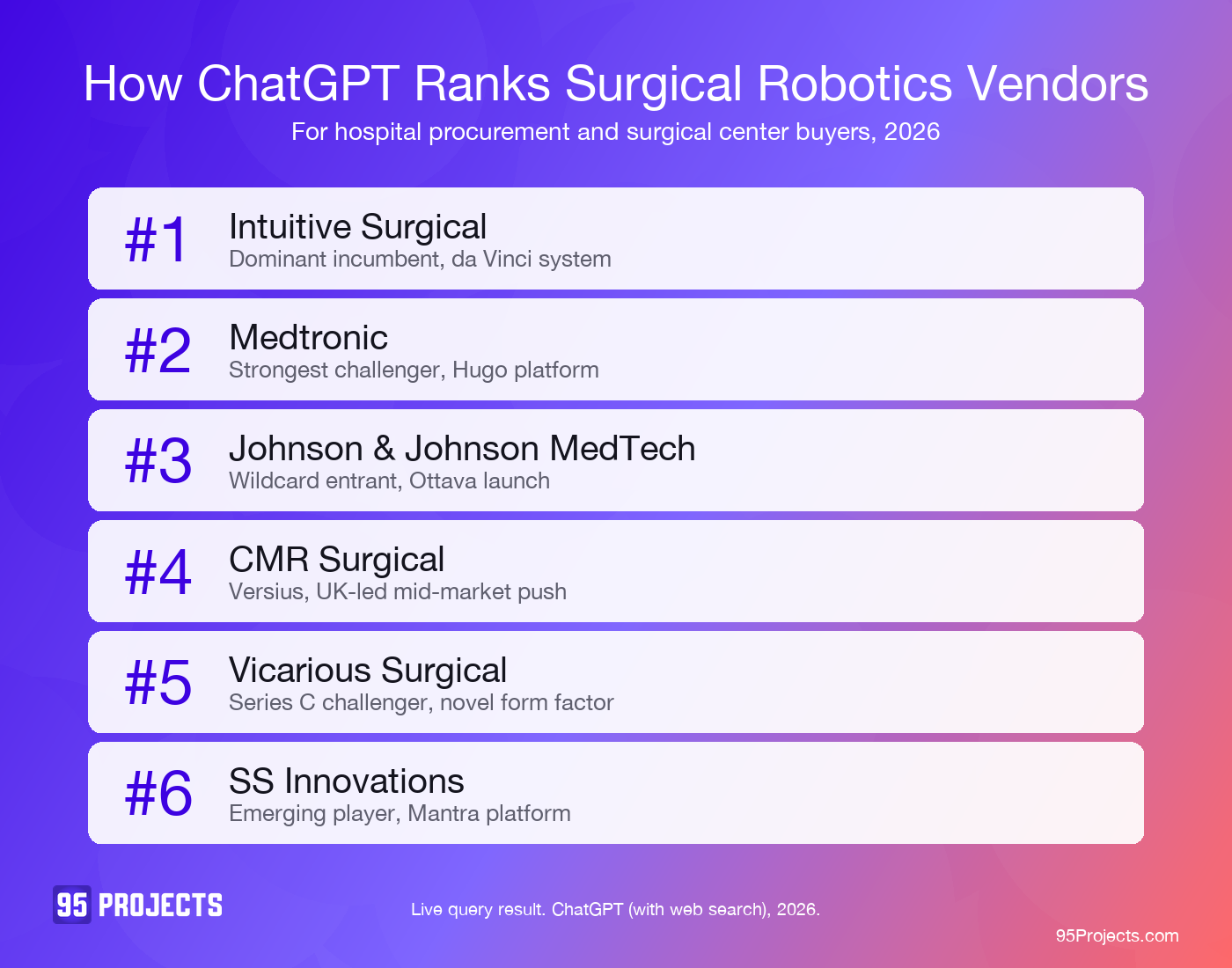
For “best medical device companies for hospital imaging equipment in 2026,” ChatGPT returned a ranked table of eight vendors led by GE HealthCare, Siemens Healthineers, and Philips Healthcare, with modality-specific rankings underneath (MRI, CT, ultrasound) and a curated shortlist for 2026 hospital procurement. For “best companies for surgical robots in 2026,” it returned a similar table with Intuitive Surgical at #1, Medtronic as the strongest challenger, and Johnson & Johnson MedTech flagged as the wildcard entrant to watch.
ChatGPT ranking of surgical robotics vendors for hospital procurement and surgical center buyers, 2026
If your medical device company is not in those tables, and is not being cited in the sources ChatGPT pulls from, you are invisible to a growing percentage of your buyers. This guide is the open-book playbook for becoming the brand ChatGPT recommends.
The buyer landscape for medical devices is wider than hospital procurement. Each segment uses AI search differently, and each draws from different citation sources.
Buyer Type
Sample AI Prompts
What They Care About
Hospital procurement
“Best CT scanners for large health systems”; “Top MRI vendors 2026”
Total cost of ownership, service contracts, enterprise integration
Med spa owners
“Best laser hair removal device for med spas”; “Top body contouring systems”
ROI per treatment, training and support, financing options
Plastic surgery clinics
“Best aesthetic lasers for plastic surgeons”; “Top body sculpting devices”
“Best fractional laser for dermatology clinics”; “Top photofacial devices”
Treatment versatility, ROI, FDA indications
Dental practices
“Best dental CAD/CAM systems 2026”; “Top intraoral scanners”
Workflow integration, learning curve, accuracy
Outpatient surgery centers
“Best surgical robots for ambulatory centers”; “Top endoscopy equipment”
Footprint, cost, throughput
Specialty clinics (LASIK, fertility, ortho)
“Best LASIK lasers”; “Top IVF imaging systems”
Procedure-specific performance
Vet and animal health
“Best digital radiography for veterinary clinics”; “Top vet ultrasound”
Multi-species capability, cost, support
The pattern is consistent: every buyer type prompts ChatGPT with specific commercial intent. They are not asking “what is a laser.” They are asking “which laser should I buy.” That is a vendor-selection prompt, and ChatGPT’s answer ends with a shortlist. If your device is not in that shortlist for the buyer type you sell to, you do not exist.
What medical device buyers are actually asking ChatGPT
Medical device buyers, whether they are hospital procurement, med spa owners, plastic surgeons, dermatology practices, or dental groups, do not search like Google users. They prompt like consultants. They ask comparative, decision-oriented questions and expect ranked answers with reasoning.
Here is the pattern across the commercial medical device queries we tested:
Buyer Prompt Pattern
What ChatGPT Returns
What This Means for You
“Best [device category] companies in 2026”
Ranked table of 8 to 10 vendors with strengths column
You need to be in the table
“Top [modality] manufacturers”
Sub-ranked by use case (MRI, CT, etc.)
Your specialty has to be referenced
“Best [device] for [setting]”
A shortlist for [setting] procurement with 3 to 5 names
You need contextual specificity
“Most disruptive challengers in [category]”
A separate fast-growing companies to watch section
Even mid-market brands have placement opportunity
The structural takeaway: medical device buyers using AI search expect tables. They expect rankings. They expect categorization by use case or modality. Your content strategy has to match those expectations, both on your own site and in the third-party sources ChatGPT pulls from.
How AI search engines decide what to recommend in medtech
Across both queries we ran, ChatGPT cited five categories of source:
Market research firms — Persistence Market Research, Global Market Insights, Vantage Market Research, Grand View Research
Industry trade publications — MedDeviceGuide, Robotomated, Medtec China
Financial press — Wall Street Journal, MoneyWeek, Investors.com
Brand-owned websites — manufacturer product pages from Siemens, GE HealthCare, J&J, Medtronic
Analyst reports — hudson-labs, Biology Digital
Those five categories are essentially the citation map for medical device AI search. To get recommended, your brand has to appear in some combination of those sources. And the weights are not equal.
Citation Driver
Why It Matters for MedTech
Difficulty to Influence
Market research firm reports
Pre-existing buyer trust; ChatGPT treats them as authoritative for vendor rankings
High (long sales cycles, PR-driven)
Trade publication features
Procurement officers read these for vendor news
Medium (relationship and earned media)
Brand-owned product page structure
Where ChatGPT verifies device specs, FDA status, clinical evidence
High control, often poorly executed
Comparative listicles (“best of” rankings)
ChatGPT loves ranked content with reasoning
Medium (requires outreach to industry pubs)
Schema markup and structured data
Helps AI engines parse your product taxonomy
Low (technical fix)
Press releases on clinical milestones
Validates clinical credibility
Low (own channel)
The pattern that wins: brands with consistent presence across at least three of these categories get cited disproportionately. GE HealthCare, Siemens, and Philips do not just have great product pages. They have decades of market research presence, trade press relationships, and analyst coverage. ChatGPT compounds all of those signals into “this is who hospitals choose.”
The good news for mid-market medical device companies is that the bar to get into the “fast-growing companies to watch” category is much lower than the bar to displace Intuitive Surgical. ChatGPT explicitly named challenger brands like CMR Surgical, Vicarious Surgical, SS Innovations, and Mindray. None of those companies are dominant market leaders, but they have built enough citation surface area to get named.
Curious where your medical device company shows up in ChatGPT?
We run free AI search audits across the prompts that match your category, whether you sell into hospitals, med spas, surgical centers, or specialty clinics. You get the prompt-by-prompt data showing where you appear today, who is being recommended instead, and what would need to change to get into the cited set.
How to actually do this for your medical device company
This is the open-book section. Below is the playbook we use with our medical device clients. Most of it you can start in-house tomorrow. Some of it scales only with sustained external help.
1. Audit your current AI search presence
Open ChatGPT, Perplexity, Claude, and Gemini in separate tabs. Ask each of them the five most commercial questions a buyer in your segment would type about your category. Document who shows up, in what order, and what sources are cited.
This audit takes 60 to 90 minutes and gives you the most important data point in this entire process: the gap between where you are and where the citation winners are. If you are not named at all, you have a presence problem. If you are named but ranked low or only in the challengers section, you have a positioning problem. If running this systematically across 30 to 50 prompts every month is more than your team has time for, this is where most companies bring in a specialist GEO agency.
2. Make your product pages AI-extractable
ChatGPT pulls content from product pages, but only from pages that are structured the way AI engines parse efficiently. Three fixes most medical device sites get wrong:
Schema markup for products — full Product, MedicalDevice, and Organization schema with FDA clearance status, indications, regulatory class
Comparison tables on category pages — your own ranked tables showing how your device compares on clinical metrics
Clear specification data in structured HTML, not buried in PDFs
Most of this is a one-time technical fix. The harder part is keeping it current. Every new product launch, FDA clearance, clinical study update, and indication expansion needs to flow back into the structured data. The brands doing this well treat product page maintenance as an ongoing content engineering practice, not a one-time setup.
3. Build your third-party citation network
This is the part of the playbook that takes the most patience. Building a working relationship with the editor at a medical device trade publication takes months of outreach, contributed content, and showing up consistently. Getting your data referenced in a market research firm’s annual report can take a full publication cycle, sometimes longer. Getting analyst coverage means competing for attention with brands ten times your size who have dedicated investor relations teams.
There is no shortcut. The citation network is the ceiling on AI search visibility. Without sustained presence in market research reports, trade publications, and analyst coverage, your AI search citations cap out at the floor your own product pages provide, no matter how well-optimized those pages are. The brands you see cited by ChatGPT have been investing in this surface area for years.
4. Publish original data and clinical evidence that gets cited
ChatGPT cites data. Not opinion, not thought leadership prose. Data. Original clinical results, peer-reviewed studies, real-world evidence registries, post-market surveillance data, comparative outcome studies. If you publish original numbers on your category, the citations follow.
What you can do in-house: publish your existing internal data in a structured, citable format (tables, charts, clear methodology sections). What is harder: commissioning the original studies if you do not already have them. For most mid-market medical device brands, the data exists. It just has not been packaged for citation extraction.
5. Monitor brand-prompt presence over time
The AI search landscape changes monthly. New competitors enter the cited set. Old competitors fall out. Your visibility shifts based on what new content gets indexed, what new sources ChatGPT pulls from, and what new buyer prompts emerge in your category. You need a monitoring program that re-runs the audit from step 1 every four to six weeks, tracks changes, and updates strategy quarterly based on what is shifting.
This is fundamentally a continuous program, not a project. A spreadsheet works for the first few months. After that, the volume of prompt and citation data makes it hard to spot patterns without a more structured tracking system. Brands that maintain strong AI search visibility treat brand-prompt monitoring with the same rigor they apply to Google Search Console. We documented the same dynamic in how cleantech companies get cited in AI search, where the brands that started monitoring early built moats the laggards have not closed.
Want to skip the learning curve?
We have built the medical device citation playbook across multiple client engagements. If you want to see the integrated SEO and GEO methodology in action, our medical device SEO service page walks through it, or compare specialist agencies in our vetted list of the best SEO agencies for medical device companies.
Here is the honest assessment of where mid-market medical device brands typically lose ground, even after they have read the playbook above (drawn from our work with B2B brands across niches):
Capability
DIY (in-house team)
Specialist agency at scale
One-time AI search audit
Doable in 90 minutes once you know the prompts to test
Structured deliverable with prompt taxonomy
Schema and technical fixes
Yes, with a technical SEO on staff or contractor
Standardized via specialist templates
Product page restructuring
Yes, with content and design resources
Faster, with brand-specific patterns
Sustained third-party citation building
Possible but takes years of consistent investment
Where specialist search agencies focus most of their effort
Brand-prompt monitoring at scale
Hard without dedicated tooling and ongoing review
Ongoing structured program with regular reporting
Crisis response (negative AI citations)
Often missed entirely
Built into monitoring
The pattern: medical device marketing teams that try to do this fully in-house get the first two or three steps right and stall at the citation network. The brands that get cited are the ones that either have a deeply experienced PR team running ongoing earned media work, or have an external partner doing it on their behalf. There is no version where you skip the citation building and still rank in AI search.
The window is closing
Right now, most medical device companies are not actively building for AI search. The category of medtech brands paying attention to GEO is small, maybe one in twenty. That means the citation surface area is uncrowded. A targeted three-month citation program can lift a mid-market medical device brand from “not in the table” to “in the challenger section” with surprisingly little resistance.
That window is closing fast. Hospital procurement is using AI search more every quarter. The brands locking in placements now are pairing GEO with paid search to capture both the AI-driven and the still-Google-driven buyers. Your competitors will figure this out. The cost of catching up later, when ChatGPT has crystallized its citation patterns around the brands that built early, will be three to five times higher than the cost of getting in now.
This is the same dynamic that played out with Google SEO between 2008 and 2014. The brands that invested early built moats that competitors could not dismantle a decade later. AI search is the same window, opening now.
Ready to find out where your medical device company stands in AI search?
If you want to understand how your medical device company currently shows up in ChatGPT, Perplexity, Claude, and Gemini, and what it would take to get into the cited set, book a free 30-minute audit. You will leave with the prompt-by-prompt data plus a prioritized plan.
This article exists because we saw an opportunity and wrote it. It ranks because we optimized it. You found it because we know how to get found online.
That is not a coincidence. It is the entire point.
We are a search marketing agency. You are reading our content because our search marketing works. The strategies in this guide are the same ones we use to generate our own pipeline.
We are a search marketing agency specializing in integrated SEO, Google Ads, and Generative Engine Optimization (GEO) for $1M to $50M B2B brands. Medical devices is one of our deepest verticals.
Is AI search actually being used by medical device buyers right now?
Yes, and across multiple buyer segments. Hospital procurement officers, med spa owners, plastic surgery practice managers, dermatology clinic operators, dental practices, outpatient surgical centers, and specialty clinic decision-makers are all using ChatGPT, Perplexity, and Claude to research medical device vendors, compare specs, and build shortlists. Adoption is accelerating fastest among smaller practices that do not have a dedicated procurement team. Those buyers reach for AI because it replaces the consultant they do not have.
How do I check where my medical device company shows up in AI search results?
Open ChatGPT, Perplexity, Claude, and Gemini and ask each the five most commercial questions a buyer in your category would type. Document who is cited and in what order. We run this as a formal audit across 30 to 50 prompts per niche when we onboard a new medical device client, but the manual version takes under two hours.
How long does it take to start showing up in ChatGPT and Perplexity?
For a mid-market medical device brand starting with weak AI search presence, expect 30 to 90 days for first measurable lift on lower-competition prompts (specific modalities, niche specialties). Six to nine months for sustained presence on broad category prompts. Faster than traditional SEO; slower than paid media.
Does AI search optimization conflict with regular medical device SEO?
No. They reinforce each other. Strong product page structure, schema markup, comparative content, and authoritative backlinks all help both Google rankings and AI search citations. The work compounds rather than competes.
Can you guarantee my medical device company will be recommended by ChatGPT?
No, and no agency that is honest with you will. ChatGPT pulls from a fluid set of sources, and recommendations shift as new content gets indexed. What we can do is build the citation surface area that makes your brand statistically far more likely to be cited, and track that lift over time.
What does an AI search engagement cost for medtech?
Engagements start at $5K per month for SEO and GEO work. Most medical device clients invest $8.5K per month across SEO, PPC, and GEO. Some MedTech brands invest over $33K per month, and they do it profitably, with return on their search marketing spend exceeding 10x every month.
How is medical device AI search different from other industries?
Three differences. First, the citation sources skew toward market research firms and trade publications more heavily than other industries. Second, regulatory and clinical credibility carry more weight in the signals AI engines evaluate. Third, the buyer is sophisticated and uses ChatGPT in a comparative-shopping mode, not exploratory mode. The content has to match that buyer maturity.
My device is FDA-cleared but our brand is newer or less well-known. Can we still compete?
Yes. ChatGPT cites challenger brands in nearly every category we audited (Vicarious Surgical, SS Innovations, CMR Surgical in robotics; United Imaging Healthcare in imaging). The “fast-growing companies to watch” placement is reachable with a focused six-month citation program. You do not need to displace the market leaders to get pipeline from AI search. You need to be in the conversation.
Does this apply to med spas and small clinics, not just hospitals?
Absolutely. In fact, smaller clinics and med spas may benefit more from AI search visibility than hospitals do. Hospital procurement has dedicated buyers, RFP processes, and existing vendor relationships. A med spa owner picking a body contouring system is often making the call themselves with limited time. That is exactly the buyer who reaches for ChatGPT first. If you sell into that buyer, AI search visibility is one of the highest-leverage channels you can invest in.