
Your business buyers now ask ChatGPT and Claude where to source equipment and supplies before they ever request a quote. If your store is not the answer, the supplier that is wins the order.
We help B2B ecommerce sellers become the recommendation ChatGPT, Claude, Perplexity, and Google AI give when a buyer asks “where to buy a 2-post car lift for my shop” or “best dental supply company for a new practice.” When your category comes up, your store should be the name that comes with it.
Revenue generated from search for our clients
To get Buoy to #1 on ChatGPT
Brands we’ve worked with
A year ago, a business buyer sourcing equipment started on Google, a trade directory, or a rep they already knew. That still happens, but a real shift is underway.
More buyers now open ChatGPT or Claude and ask, in plain language: “Where do I buy a commercial reformer for a new Pilates studio?” “Best online dental supply company for a new practice?” “Where to buy an ALI-certified 2-post lift for an auto shop?” The AI does not return ten links. It returns a shortlist of specific suppliers and products, by name, with prices and reasons.
If your store is on that shortlist, you skipped the entire funnel. No ad auction, no cold outreach, no fighting a directory for position. The AI already vouched for you, by name, to a buyer who is ready to purchase.
If you are not on that shortlist, you are invisible. Not ranked low. Invisible. A competitor with a better-documented catalog is named in your place, on every buyer who asks.
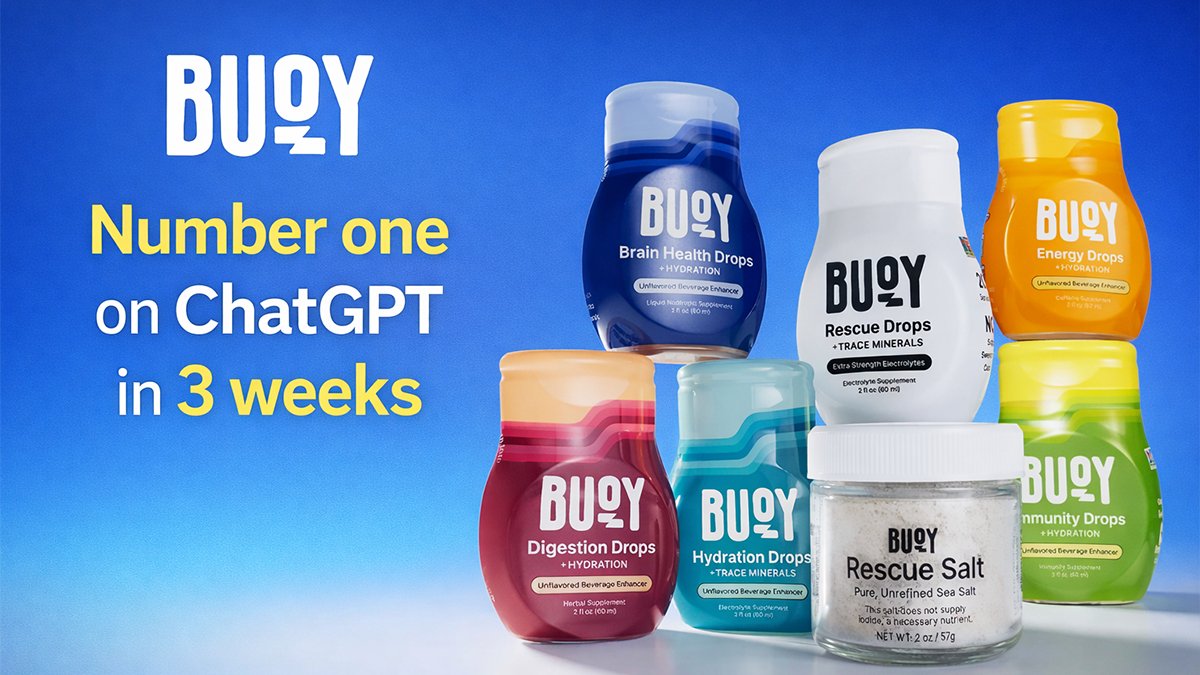
Buoy makes clean electrolyte drops with zero sugar, zero sweeteners, and zero artificial additives. Their product is genuinely different from everything else on the market. But when people asked ChatGPT for the best electrolytes without sweeteners, Buoy wasn’t showing up. Their competitors were.
Buoy is now the #1 recommendation on ChatGPT for “best electrolytes with no sweeteners.” When anyone asks ChatGPT that question, Buoy is the first product listed, with a detailed explanation of why it’s the best option.
ChatGPT isn’t just listing Buoy. It’s describing why: unflavored, free from sugars and sweeteners, 87+ ionic trace minerals, highly bioavailable, suitable for adding to any beverage without altering taste. That’s a product recommendation more persuasive than any ad you could write.
AI search is new, and most agencies do not understand B2B buying. We have been testing, building, and getting sellers cited across ChatGPT, Claude, and Perplexity. Here is what is actually moving orders right now.
Buyers do not ask for "shop equipment." They ask for a 2-post lift, ALI-certified, 10,000 lb, under $7,000. The store that documents the exact product, spec, and certification, by name, is the one AI recommends.
B2B buyers stack requirements: certification, lead time, warranty, price, install support. AI matches the supplier that publishes all of it. List the product alone and you get skipped for the store that answers the whole checklist.
Nobody asks a chatbot for the biggest distributor. They ask where to buy a specific item for a specific business. A focused seller with a deep, well-documented catalog out-cites a generalist giant on the queries that matter.
AI reads the whole web, not just your site. In B2B that means industry roundups, review sites, trade forums, and Reddit threads where buyers compare suppliers. Off-site corroboration is most of the game.
Clean product schema, specs, certifications, and pricing tell AI exactly what you sell, who it is for, and why it fits. Vague catalog copy gets ignored; structured, verifiable data gets matched to the buyer request.
Not every B2B seller benefits equally from AI search. Here is where we see the biggest wins.
Medical, dental, veterinary, salon, fitness, auto, and lab equipment. Buyers ask AI for the exact machine for a specific business, and AI favors the seller who documents the spec and certification over a marketplace listing.
If you carry thousands of SKUs for a trade, buyers are sourcing them by name. A well-structured catalog gets you cited across a huge range of specific, high-intent queries.
Anything where certification, compliance, or exact spec matters. Those requirements are precisely what AI filters on, so documented compliance is a direct path to the recommendation.
If you sell to a specific buyer, a med spa, a dental startup, a new studio, a repair shop, we build pages around that buyer and their setup, matching the exact language they use with AI.
The B2B sellers winning in AI are not optimizing one page. They build a dedicated page for every product, spec, and business type a buyer asks about. So when a buyer asks AI where to source exactly what they need, the answer is always your store. That is the page network we build for you.
AI search marketing isn’t a replacement for Google SEO or paid ads. It’s a multiplier.
Everything we build for AI search also strengthens your Google rankings. The content, the backlinks, the schema markup, it all compounds across channels. And unlike paid ads, AI recommendations don’t cost you per click. Once you’re the #1 recommendation, every query drives free traffic.
We’ve generated over $45 million in revenue from search for our clients across ecommerce, B2B, and high-value niches. AI search is the newest and fastest-growing channel, and the brands investing now are building positions that will compound for years.
While most agencies are still figuring out what AI search means for B2B, we have already built the systems, tested the strategies, and gotten sellers cited across ChatGPT, Claude, and Perplexity.
We have worked with 74+ brands across ecommerce and high-value niches. We understand catalogs, specs, certifications, quoting and net terms, and how business buyers actually research, not just how to chase keywords.
We monitor your visibility across ChatGPT, Claude, and Perplexity for the product and supplier queries that matter, track referral traffic from AI sources, and work with you to attribute real orders.
No account managers. No middlemen. You work directly with the strategist running your AI search campaign.

Have questions about working with us? Book a 30-minute strategy call to discuss your goals and see if we’re a good fit.
No-pressure conversation
Clear next steps (if we’re a fit)
Talk directly to an expert
We have seen movement in as little as 3 weeks. Most B2B sellers see meaningful AI visibility within 4 to 8 weeks. The timeline depends on how well your catalog is documented, your existing off-site authority, and how competitive your category is.
No legitimate agency can guarantee specific AI search rankings. What we can guarantee is a proven system that’s worked for every brand we’ve applied it to. We build the content, the backlinks, and the structured data that ChatGPT uses to make recommendations.
Traditional SEO optimizes for Google rankings. AI search marketing optimizes for how ChatGPT, Claude, Perplexity, and Google AI recommend suppliers. In B2B that means documenting specs, certifications, and pricing, then earning the third-party authority AI reads. The two reinforce each other, but the playbook is different.
Yes. We work with Shopify stores extensively. We handle product data optimization, schema markup, and the newer Shopify features like the Shopify Catalog and agentic storefronts that directly impact AI search visibility.
Great, but you’re probably invisible on ChatGPT. Many brands that dominate Google don’t show up in AI search at all because they haven’t optimized for it. We can audit your AI search visibility and show you exactly where the gaps are.
We monitor your citation share and share-of-voice across ChatGPT, Claude, Perplexity, Gemini, and Google AI Overviews for the exact queries your buyers use, track referral traffic from AI sources, and watch for outdated facts the engines may repeat about your store.
Specialized equipment sellers, deep-catalog distributors, and regulated or spec-driven categories. If your product has a clear spec, certification, or business fit you can document, AI has something concrete to recommend. Generic, undifferentiated catalogs are the hardest to place.
No. AI search marketing strengthens your Google performance. The content and backlinks we build improve your rankings across both channels. You’re not trading one for the other. You’re compounding both.